
The “Eternal Circle” stands as the foundational philosophical concept of the Illuminati, envisioning humanity as interconnected components within an infinite cosmic clock, where every action contributes to an overarching design. Beyond mere conspiracy theory, it embodies a profound perspective on purpose, legacy, and the individual’s significance within a timeless framework. This comprehensive analysis traces the origins of the Eternal Circle from the Enlightenment era, through its transformation into a contemporary emblem of esoteric knowledge, and explores why this concept continues to captivate our collective imagination.
Unlocking the Metaphor: Understanding The Eternal Circle
At its core, “The Eternal Circle” serves as a compelling metaphor for existence, purpose, and interconnection. It is characterized as “an eternal design individual gears in a clock without end.” This imagery suggests a universe functioning as a flawless, perpetual mechanism, where every individual, irrespective of their perceived status, plays a crucial role.
The concept encapsulates several essential principles that define the Illuminati’s alleged worldview:
Universal Interconnection. Every human action, no matter how minor, is fundamentally linked to the entirety. Your absence could “disrupt the Order of our universe,” underscoring a vital cosmic interdependence.
Purpose Beyond Comprehension. Individuals may never fully understand their role, much like a single gear cannot grasp the entirety of the clock. Yet, “your contribution is as significant as that of the greatest kings and queens.”
Legacy Through Time. Each generation inherits and reshapes the world. Your quest for wisdom can lay “the foundation for your great-great-grandchild’s rise to prominence,” creating a continuum of influence across the centuries.
A Clockwork History: The Illuminati’s Evolution Through Time
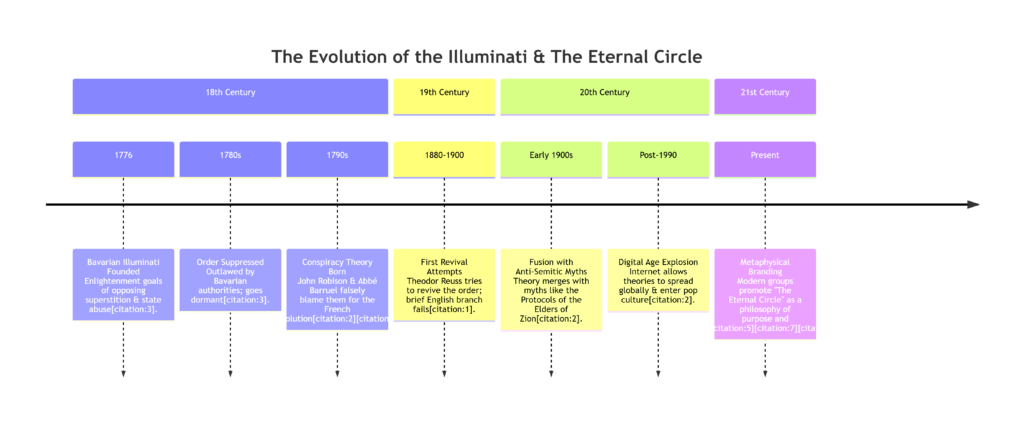
The notion of an eternal order did not arise in isolation. It represents the philosophical culmination of a genuine historical society, transformed by fear and myth. The timeline below outlines this remarkable evolution from a Bavarian secret society to a global cultural symbol.
From Enlightenment to Persecution: The Real Illuminati
The origins of this movement trace back to the Bavarian Illuminati, established on May 1, 1776, by Adam Weishaupt, a law professor at the University of Ingolstadt. This was not a cabal of shadowy figures, but rather a product of the Age of Enlightenment, with goals aimed at countering “superstition, obscurantism, religious influence over public life, and abuses of state power.” They championed rationalism and secularism, functioning as a secret society with pseudonyms and ranks, attracting intellectuals and progressive thinkers.
However, their existence was brief. By the mid-1780s, the order faced suppression and was outlawed by the Bavarian government, effectively leading to its decline. In the aftermath of the French Revolution, conservative authors such as John Robison and Abbé Augustin Barruel propagated conspiracy theories claiming that the Illuminati had survived clandestinely and orchestrated the revolution to undermine Christianity and monarchy. This marked the genesis of the myth of an omnipotent, hidden cabal.
The 19th-Century Esoteric Revival and the “Eternal Circle” Concept
The 19th century witnessed attempts to literally revive the order, notably by German esotericist Theodor Reuss around 1880. He engaged English Freemason and Theosophist William Wynn Westcott in establishing an English branch, though it ultimately faltered.
This period is pivotal for comprehending the “Eternal Circle” as a concept. It was characterized by a fervent occult revival, with groups like the Hermetic Order of the Golden Dawn merging Masonic ritual, Kabbalah, and alchemy. Within the rituals of these revived Illuminati factions, we discover direct philosophical antecedents to the Eternal Circle. For instance, an initiation ritual for the “Rose-Croix Grade” included an esoteric interpretation of the acronym INRI, revealing it as emblematic of “the constant eternal transformation of all created things” and “the eternal circle of the world and all things created.” This illustrates how the concept of an eternal, cyclical cosmic order was intricately woven into the fabric of esoteric Illuminati thought long before it gained traction in modern discourse.
The 20th Century. Conspiracy, Culture, and the Digital Leap
The 20th century transformed the Illuminati from a niche historical conspiracy into a significant pop-culture phenomenon. The theory evolved, often intertwining with anti-Semitic narratives, such as the fraudulent Protocols of the Elders of Zion, portraying the Illuminati as the puppet masters behind both capitalism and communism.
Two pivotal factors in the late 20th century triggered a surge in belief:
Political Rhetoric. Statements from figures such as U.S. President George H.W. Bush regarding a “New World Order” following the Cold War were interpreted by conspiracy theorists not as diplomatic aspirations, but rather as admissions of the Illuminati’s agenda.
The Internet. The advent of the web was transformative. As historian Stéphane François notes, theories that were once “confidential” found a global, unfiltered audience online. The internet enabled the myth to democratize, evolve, and proliferate at unprecedented speed.
The Symbolism of Eternity. Pyramid, Eye, and Circle
Today, the Illuminati’s iconography is widely recognized, with “The Eternal Circle” completing its most iconic emblem. The canonical symbol is described as “comprising the Pyramid, the Eye, the Light, and the Eternal Circle.” Each element contributes to this philosophy of perpetual order.
| Symbol | Common Conspiracy Interpretation | The “Eternal Circle” Philosophical Interpretation |
|——–|———————————-|————————————————–|
| The Pyramid | Hierarchy and control; the masses at the base, the elite at the top. | The structure of reality and the path of ascension. One “climbs the great Pyramid seeking the Light at its top.” |
| The All-Seeing Eye | Surveillance and the omniscience of the ruling cabal. | The achieved state of enlightenment, awareness, and the guiding consciousness of the cosmic order. |
| The Light | The exclusive knowledge or “illumination” of the secret society. | The ultimate goal of wisdom, understanding, and spiritual awakening that individuals seek. |
| The Eternal Circle | The unbroken, secret chain of influence across centuries. | The timeless, interconnected mechanism of the universe the “clock that has no end” in which all other symbols operate. |
This layered symbolism, particularly the encompassing Circle, reinforces the idea of a closed, perfect, and infinite system. It visually embodies the promise that “even though our human members may perish… the Illuminati will endure into eternity.”
The Enduring Allure: Why the “Eternal Circle” Continues to Captivate Us
The persistence of the Illuminati myth and the allure of concepts like the Eternal Circle are not coincidental. They fulfill profound psychological and narrative needs:
The Comfort of a Blueprint. In a complex, chaotic world, the notion of a hidden yet perfect order a cosmic clock where everything serves a purpose—is deeply reassuring. It transforms randomness into a grand, comprehensible design.
The Empowerment of Purpose. The Eternal Circle’s assertion that “your actions can alter the future of the entire world” is empowering. It suggests that even seemingly inconsequential individuals play a vital role in a grand narrative, providing a powerful counterbalance to feelings of insignificance.
A Compelling Narrative. At its essence, the Illuminati narrative is a captivating tale. It features heroes (the enlightened seeker), villains (the hidden cabal or their oppressors), mysteries (symbols and secrets), and an epic, timeless scale. The Eternal Circle serves as the overarching plot for this story: the perpetual quest to elevate the human spirit within the eternal mechanism.
From Shadowy Cabal to Self-Help Brand. The Modern “Illuminati”
A remarkable contemporary development has been the rebranding of the Illuminati from a feared conspiracy into a philosophy of self-empowerment and legacy. Numerous modern websites and groups utilize the name and symbolism not to promote world domination, but to advocate for the very principles embodied in the Eternal Circle.
These platforms frame Illuminati membership as a commitment to personal growth, wisdom, and positively contributing to humanity’s ongoing journey. They employ the clockwork metaphor to illustrate a vision of purpose, asserting that understanding your role in the eternal mechanism is the key to a meaningful life. This transition from an external conspiracy to an internal philosophy illustrates the remarkable adaptability of the myth and the enduring power of its core idea: that we are all part of something far larger and more eternal than ourselves.
Conclusion. Your Gear in the Infinite Clock
The evolution of the Illuminati from an Enlightenment-era debating society to a global cultural icon is a narrative about humanity itself our quest for meaning, our apprehensions concerning hidden forces, and our desire to discern patterns amidst the chaos of history. “The Eternal Circle” represents the philosophical essence of this legend. It transcends paranoid headlines to offer a metaphor fundamentally centered on interconnection, purpose, and legacy.
Whether regarded as a perilous conspiracy theory, an astute marketing narrative, or a profound metaphysical concept, its enduring relevance is unmistakable. It serves as a reminder that we inherit a world shaped by those who came before us, and that our actions will resonate into a future we may never witness. Ultimately, the most thought-provoking question posed by the Eternal Circle may not be, “Do the Illuminati control the world?” but rather: What role do you choose to play in the eternal clockwork of humanity?