
The Illuminati is a name given to both a real 18th-century secret society and the powerful, shadowy cabal of modern conspiracy theories. The original Bavarian Illuminati, founded in 1776, sought to spread Enlightenment ideals of reason and oppose religious influence. The mythical Illuminati, in stark contrast, is accused of being an all-powerful group manipulating world events from the shadows to establish a “New World Order“.
If you’ve ever wondered about the mysterious symbols on the dollar bill, heard rumors about celebrity members, or questioned who really controls global events, you’ve encountered the modern myth of the Illuminati. But where did this idea come from, and is there any truth to it?
This definitive guide separates historical fact from popular fiction, tracing the journey of a small intellectual club into one of the world’s most enduring conspiracy theories.
The Birth of the “Enlightened Ones”: A Historical Primer
The story begins not with shapeshifting reptilians or a Hollywood cabal, but in a Bavarian university town in the Age of Reason.
Adam Weishaupt and the Original Mission
In 1776, a 28-year-old German law professor named Adam Weishaupt founded a secret society in Ingolstadt. Frustrated by the rigid control of the Jesuit order at the University of Ingolstadt and inspired by Enlightenment philosophers, Weishaupt dreamed of a society free from religious dogma and monarchical abuse.
He initially called his group the “Order of the Perfectibilists,” but soon adopted the more resonant name “Illuminati,” meaning the “enlightened ones”. Their official goal was noble: to oppose superstition, obscurantism, and the abuses of state power.
Structure, Secrecy, and Symbols
The Bavarian Illuminati was organized with meticulous, almost spy-like secrecy. To protect their identities in an era of political repression, members used classical pseudonyms; Weishaupt himself was “Spartacus”.
- Hierarchy: New members entered as Novices, advanced to Minervals, and could become Illuminated Minervals. The “Minerval” grade was named for Minerva, the Roman goddess of wisdom, whose owl became a key symbol of the order.
- Recruitment: They specifically sought young, wealthy, and influential men, believing them to be malleable and future leaders. They famously infiltrated Freemason lodges, seeing them as fertile ground for recruiting like-minded individuals.
- Espionage: A system of mutual surveillance was encouraged. Members reported on each other and on the activities of religious and state figures, building dossiers of information.
At its peak in the early 1780s, the order grew to between 1,500 and 2,500 members across Europe, including literary figures like Johann Wolfgang von Goethe and various German nobles.
The Sudden Fall
The society’s radical, anti-clerical writings eventually drew the attention of Bavarian authorities. In 1785, Duke Karl Theodor of Bavaria issued an edict banning all secret societies, including the Illuminati.
Police raids on members’ homes uncovered compromising documents, and the group was violently suppressed. Weishaupt was stripped of his professorship and banished from Bavaria. By 1787, the historical record shows no further activity of Weishaupt’s original Illuminati.
From History to Myth: The Birth of a Conspiracy Theory
Ironically, the group’s suppression was the catalyst for its legendary afterlife. The conspiracy theory was born almost immediately.
- The First Accusations (1790s): In 1797, two books one by Scottish physicist John Robison and another by French Jesuit Abbé Augustin Barruel independently argued that the Illuminati had not died but had gone underground to mastermind the French Revolution. This is considered by many to be one of the world’s first modern conspiracy theories.
- American Fears: The panic spread across the Atlantic. In 1798, even George Washington addressed the “Illuminati threat” in a letter (though he believed America had avoided it). Political opponents falsely accused President Thomas Jefferson of being a member.
- The Anti-Semitic Turn: The conspiracy evolved dangerously in the early 20th century. To explain the trauma of the Russian Revolution, writers like Nesta Webster merged the Illuminati myth with the virulently anti-Semitic Protocols of the Elders of Zion, creating the toxic idea that the Illuminati was a front for Jewish elites seeking world domination. This linkage remains a dark undercurrent in some modern conspiracy circles.
The Modern Myth: Symbols, Celebrities, and “New World Order”
The Illuminati we recognize today a global cabal of celebrities, politicians, and billionaires is largely a product of 20th-century counterculture and the internet.
The 1960s Reinvention
The modern myth was ironically and deliberately created. In the late 1960s, writers Robert Anton Wilson and Kerry Thornley, adherents of a parody religion called Discordianism, began a “psy-op” to spread chaos. They submitted fake letters to magazines, alternately claiming and denying the Illuminati’s involvement in events like JFK’s assassination.
Their goal was to make people question official narratives. This experiment in “guerrilla ontology” spun wildly out of control with the publication of Wilson’s satirical The Illuminatus! Trilogy in 1975, which became a counterculture sensation and cemented the group’s image in popular imagination.
Decoding the Symbols
A key feature of the modern conspiracy is the “decoding” of hidden symbols believed to be Illuminati signatures:
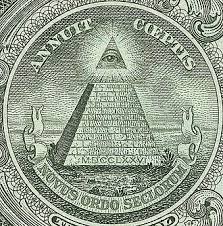
- The Eye of Providence: The eye in a triangle on the back of the U.S. one-dollar bill is the most famous “clue”. Conspiracy theorists claim it as an Illuminati symbol of surveillance and control. Historically, it’s a Christian symbol representing God’s watchfulness, used by the Founding Fathers and Freemasons with no connection to the Bavarian group.
- The Owl of Minerva: This was the actual symbol of the historical Bavarian Illuminati, representing wisdom. It is often conflated with the more generic “all-seeing eye” in modern myths.
- Pyramids, Pentagrams, and 666: These are often cited as evidence in music videos, award shows, and corporate logos. This practice exemplifies “apophenia” the human tendency to perceive meaningful connections between unrelated things.
Celebrity “Members”
The theory thrives on implicating the ultra-famous and powerful. Figures like Beyoncé, Jay-Z, and Madonna are often “accused” due to their use of triangle motifs, occult-inspired imagery, or sheer cultural influence.
Most celebrities dismiss the claims. Jay-Z has called them “stupid,” and Kanye West labeled them “ridiculous”. To believers, these denials are simply proof of the conspiracy’s effectiveness.
Why Do People Believe? The Psychology of Conspiracy Theories
Belief in the Illuminati isn’t necessarily about historical facts; it’s about fulfilling deep psychological and societal needs.
- Simplifying Complexity: The world is chaotic and unfair. The idea that a single, powerful group is behind all major eventsrecessions, wars, pandemics provides a simple, ordered explanation for complex, frightening phenomena.
- Coping with Powerlessness: For those who feel left behind by globalized economies or distant political systems, the conspiracy theory re-frames powerlessness. You’re not ignored by a complex system; you are a truth-seer, heroically resisting a deliberate, evil plot.
- The Lure of Secret Knowledge. Believing you possess hidden truth that “they” don’t want you to know can be empowering and create a strong sense of in-group identity among believers.
The internet has been the ultimate catalyst, allowing these ideas to spread, mutate, and find communities at lightning speed, transforming a niche belief into a global meme.
Conclusion: Separating Fact from Fantasy

So, what is the Illuminati?
- Historically: It was a short-lived Enlightenment-era secret society in Bavaria (1776-1785) that advocated for reason, secularism, and reform before being crushed by the state.
- In Myth: It is a blank-screen conspiracy theory, a modern folklore monster onto which we project our anxieties about power, control, and change in a globalized world.
The real legacy of Adam Weishaupt’s club is not a New World Order, but a powerful demonstration of how easily history can be twisted into myth, and how our timeless need for explanation can create stories more enduring and often more compelling than reality itself.
The next time you see a “hidden symbol” or hear a rumor about a secret meeting, remember: the most illuminating truth about the Illuminati is what its enduring myth reveals about us.